Rolfing® Structural Integration
Structural integration means bringing the body’s structures together into a whole, following the systematic approach developed by its founder, Ida Rolf.
The method dates back to the 1940s. Ida Rolf worked from the premise that the arrangement of the body’s structures and the relationships between them influence how a person stands and moves in gravity. She was interested in how work with connective tissues could affect these relationships. Working with fascia became the starting point for her approach to the body as a whole.
Rolfing developed in the twentieth century within a wider field of bodywork approaches that also includes the Feldenkrais Method and the Alexander Technique. These approaches, now described as somatic, share an interest in the relationship between movement habits, bodily awareness and the ability to learn new ways of moving. The Feldenkrais Method develops this learning through guided movement lessons and individual work using touch. Movement and postural approaches, including the work of Moshe Feldenkrais, also influenced Ida Rolf’s approach.
In the 1960s and 1970s, she also developed movement education and work with bodily awareness in collaboration with educator Dorothy Nolte and dance educator Judith Aston. In 1971, she founded the Rolf Institute of Structural Integration, which became a centre for teaching the method. Subsequent generations of Rolfers have built on her work. Rolfing continues to develop, drawing on knowledge of fascia, movement and bodily awareness.
Fascia
Fascia is an extensive system of connective tissue that runs throughout the body. It surrounds muscles, bones, nerves, internal organs and other structures, connects them and helps transmit forces during movement. It also contains nerve endings and contributes to our sense of the body’s position and movement. Fascial tissues respond to pressure, tension and movement, and their structure and properties adapt over time to the loads placed on them.
About the illustration
Study after S. Paoletti, Les fascias (1998), fig. 76; source: U. J. Gerlach and W. Lierse (1990), illustration by Peter Sommerfeld.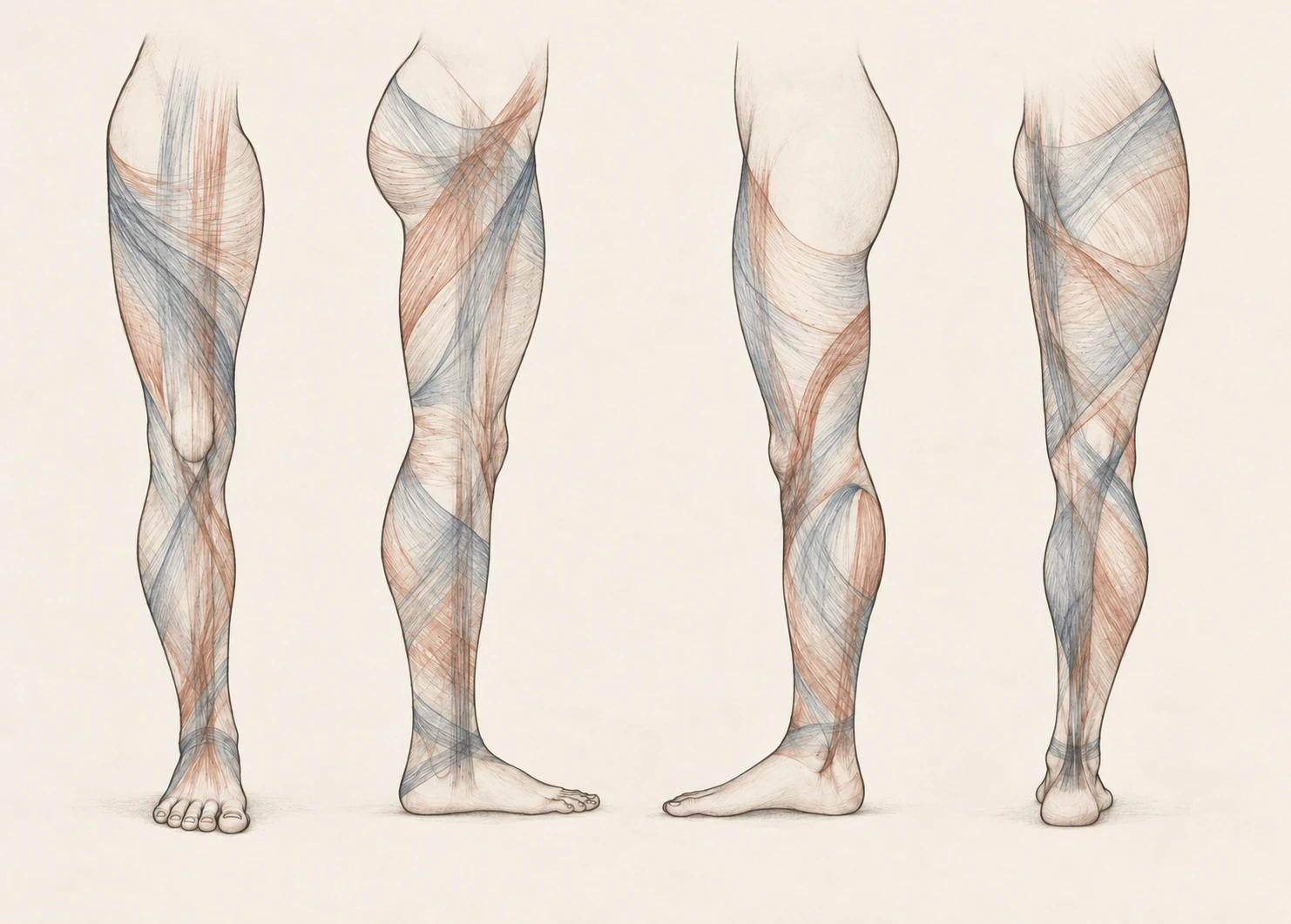
Rolfing sees work with fascia as part of reorganising the whole body in relation to the forces of gravity. We use focused touch to work with fascia and other soft tissues while you lie on a treatment table, sit or stand. We adapt the depth and intensity of contact to our “reading” of the tissues and to your feedback. Together, we also explore walking and other movement habits, paying closer attention to how you experience your body. Our aim is to discover new ways of finding support and moving in gravity with less unnecessary effort, explore new movement patterns and help you live with greater awareness and confidence in your body.
My approach
I understand the body’s structure — how it is organised — in relation to its function: the activities we repeat. What we initially learn gradually becomes a natural part of how we function. Structure and function are therefore connected processes unfolding over different timescales. Function is expressed through a particular activity; structure includes relationships and patterns that have become established and persist over time.
In this broader view, I draw on Hubert Godard’s model of four structures.
Physical structure includes the body’s tissues and the relationships between them.
Coordinative structure consists of the learned patterns through which the different parts of the body work together in movement.
Perceptual structure concerns the information we pick up from our body and surroundings, what we pay attention to and how these perceptions orient us in time and space.
Symbolic structure includes the personal and cultural meanings associated with our posture and gestures — for example, what it means to us to stand upright, take up more space or move closer to someone.
In my work, I take all four structures into account, paying attention to what “supports” change and what “maintains” existing habits. I see their interplay as the basis of overall and, above all, lasting integration.
For curious readers
If you are interested in the connections between the body’s structure, movement and perception, these books offer further reading.
Reimagining the Body: Somatic Practice, Embodiment, and the Science of Movement
An introduction to Hubert Godard’s approach to movement, perception and orientation in gravity. The book brings together stories from practice, research and experiential exercises that let you explore these ideas in your own body.
Fascia: What It Is and Why It Matters
An introduction to the structure and functions of fascia. Lesondak explains its relationship to movement and bodily awareness, relating current knowledge to the history of connective tissue research.
Functional Atlas of the Human Fascial System
A detailed anatomical atlas for readers who want to explore the layers of fascia and their relationships with muscles, nerves and blood vessels. Anatomical photographs are complemented by microscopic images and explanations of tissue structure.